
In Cages With Open Doors – On Learned Behaviours and Rules That Outlive Their Purpose
ByGV Ravishankar
Published
Processes often begin as solutions, but over time they harden into muscle memory that crowds out first-principles thinking.
A few weeks ago in Singapore, I found myself at a popular Indian restaurant at one of the heritage hotels. It’s one of those restaurants where the weight of history shows up in small details – the quiet confidence of the space, the way nothing feels rushed, the sense that it has been doing this for a long time and sees no reason to explain itself.
We arrived at around 6:40 pm. The restaurant officially opened at 7 pm. The doors were open. One of the tables was occupied, and a staff member was standing next to the table. Lights on, staff moving around, everything giving off the impression that service had begun.
So we walked in.
The manager, who was the one standing at the occupied table, greeted us warmly, checked his watch, and told us the restaurant wasn’t open yet. He walked us back to the door and told us politely we could wait outside and they would seat us in 20 minutes. He then went back to the table where he was briefing the staff.
Nothing about the interaction was unpleasant. In fact, it was perfectly courteous. But something felt oddly hollow. The restaurant was empty. We could have easily been seated at a table, given a menu, and told that they would take orders at 7 pm. Yet, we were escorted outside and asked to wait, only for the manager to go back to his staff.
It left me wondering if hospitality was present in form, but absent in spirit. I even imagined the manager going back to his staff and instructing them on the importance of customer service and delight while missing the chance to demonstrate that in action with us.
It stayed with me longer than it should have, as I kept wondering what would have been lost if we had simply been seated inside. Probably nothing. And what might have been gained? A small, unnecessary kindness. A sense of being welcomed rather than processed.
When Rules Outlive Their Purpose
Processes rarely begin as constraints. They begin as solutions, as pointers, so that less individual judgment can be applied to achieve desired outcomes.
Restaurant opening time mattered because kitchens need preparation, staff need coordination, and expectations need to be managed. All reasonable. But over time, that logic hardens into policy and policy becomes muscle memory.
No one intends to create processes that take business away from their essence. It happens gradually, as judgment is replaced by compliance. As discretion becomes risk. As doing something slightly out of script starts to feel unsafe and non-compliant with structure.
What’s interesting is that the moment at the restaurant didn’t feel like bad service. It felt like empty service. Everything was done correctly, and yet the soul was missing.
I’ve been thinking about what else we do in businesses or in our lives which have gone from being a purposeful guide to being a soulless form.
The Airline Conversation
On my flight back shortly after, I was talking to a flight attendant about an upgrade that I had just received. As a frequent flyer, I occasionally find myself bumped up, seemingly at random. I had always assumed this had something to do with loyalty, history, or some invisible algorithm trying to delight me.
The reality was surprising.
Upgrades, she explained, usually have nothing to do with customer delight. They’re a side effect of overbooking. When Economy class fills up, someone moves up. When Business fills up, someone gets bumped to First. I learned that upgrades are a pressure-release valve, not a generosity program.
What struck me wasn’t the logic—it made operational sense—but how little discretion existed around it. Loyalty rewards weren’t moments of judgment; they were logistics lotteries. The system was so tightly optimized around rules that customer delight became incidental rather than intentional.
Once again, nothing felt broken. Here was a system doing exactly what it was designed to do and that was the problem.
The Invisible Ceiling
I was reminded of a simple experiment often told about fleas in a jar. Put fleas in a jar with a lid, and they’ll jump repeatedly, hitting the top. Over time, they adjust. They stop jumping as high.
Eventually, the lid is removed. The fleas don’t escape. They continue jumping to the same height, as though the lid were still there.
The story is often told as a metaphor, but it’s uncomfortably accurate. We do this all the time. A few failed attempts, a few corrections, a few rejections, and we recalibrate. We adjust our sense of what’s possible instead of adjusting our strategy. This behavior solidifies into our personality.
At some point, the original constraint disappears. The context shifts. But our behavior doesn’t. The ceiling moves. We don’t. Business constraints disappear, but the process remains and is ingrained in how the organization thinks.
How Beliefs Harden
What makes this particularly tricky is that these limits and structures often aren’t imposed. They feel learned.
We do something or do as per what someone has asked us, we get a nod of approval then do it again. We do it to comply or to get approval. We tell ourselves we’ve learned something. We’ve “understood how the organization/world works” and we keep repeating that behavior.
Over time, small adaptations accumulate. We stop suggesting ideas that didn’t land once. We stop asking questions that make us look naïve. We stop reaching for things that didn’t work out the first time.
Eventually, these choices turn into traits. Our learned behaviors become part of our personality.
“I’m not the kind of person who speaks up.”
“I’m better as a supporting act.”
“I don’t take risks like that.”
The language shifts from behavior to identity. And once something becomes identity, it becomes difficult to question.
Organizations Learn This Too
The same thing happens as companies scale.
A young company moves fast because it has to. Decisions are made with imperfect information. People rely on judgment. As the organization grows, processes are introduced. Again, for good reasons. Complexity demands structure.
Then something subtle happens. The process becomes the work. The checklist replaces the conversation. The safest decision becomes the default one. Processes replace first principles thinking.
Eventually, people stop asking whether something makes sense and start asking whether it will get them into trouble. Employees end up asking, “What if it fails,” replacing the founder’s DNA that asks, “What if it works?” They end up not taking risks and staying in the jar. Organizations stop innovating.
From the outside, everything looks functional. From the inside, it often feels lifeless. People move out and new people come in, only to be told “This is how things are done here.”
Why We Stay Inside
It would be easy to frame all of this as a process that is bad or as a failure of systems or leadership. But that would miss something important.
Underlying all of this is a discomforting truth: cages offer comfort.
They remove ambiguity. They limit exposure. They tell us where the edges are so we don’t have to find them ourselves. And we as humans seek that comfort.
“If the rule says no, the decision isn’t mine.”
“If the policy forbids it, the risk isn’t mine.”
“If the identity constrains me, people understand that’s how I am.”
These are the narratives we use to stay within the lines.
Freedom and first principles thinking sound appealing until you realize it comes with accountability. And accountability comes with the possibility of getting it wrong.
So we stay put. We adjust our jumps. We learn to live within the space we’ve defined and end up becoming prisoners of our own personalities.
Testing the Door
Breaking out of these invisible cages doesn’t require dramatic gestures. It starts with noticing.
Noticing when a rule is followed without reflection. Noticing when an old self-description dictates present choices. Noticing when the reason something “can’t be done” has outlived its original context.
Learn to ask why something is done a certain way. Why does digital money transfer have to wait for government holidays or weekends? Why is the woman in a family the homemaker when both people are working?
Sometimes, after inspection, the constraint still holds. That’s fine. Not every rule needs breaking. Not every limit is imaginary.
But occasionally, you realize the door has been open for a while.
One Question Worth Asking
As we enter the New Year, one question may be worth asking: Am I actually constrained here, or am I behaving as though I am?
Sometimes the answer is uncomfortable. Sometimes it’s liberating. Often, it’s both. Because every now and then, you realize you’re standing in a cage with the door already open or in a jar with the lid open.
And the only thing left to decide is whether you’re willing to jump again. Wishing you a happy leap into 2026!
RECOMMENDED READS
Three articles I found interesting:
- This Medium article discusses how digital media, including social apps and podcasts, has shifted toward continuous, algorithm-driven video, making it increasingly resemble traditional television. Content flows endlessly, and conversation and networking are limited, even on social platforms. When all our time and attention are focused on television drama, it shapes who we are, how we react, and what we become.
- Warren Buffett, the Oracle of Omaha, recently stepped down as CEO of Berkshire Hathaway after a storied career that reshaped investing. As an era closes, this article revisits a guiding principle: know your circle of competence. Buffett’s lesson favors a disciplined understanding of what you know best. This truly is evergreen advice.
- For as long as I can remember, being well-rounded has been held in high regard. In this blog, Atlassian approaches personal development through a new lens, inviting you to stop sanding down your edges in pursuit of balance. Instead, it encourages you to lean into what you do best, cultivating depth while staying curious at the margins. I have often referred to this as “the spear versus the sphere” – having a sharp spike takes you further!
If you have time for longer reads:
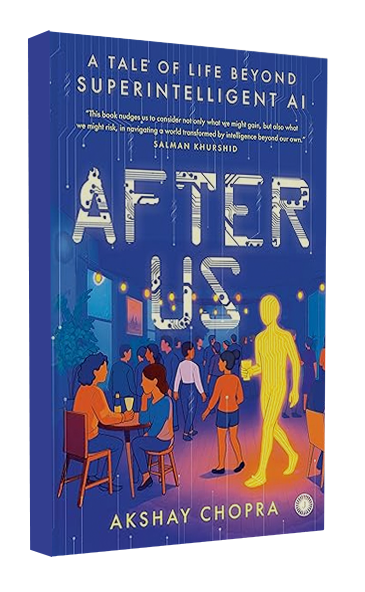
After Us: A Tale of Life Beyond Super Intelligent AI
by Akshay Chopra
Written by a good friend and technologist Akshay Chopra, this book has quickly become an Amazon bestseller in the UAE. Akshay’s sci‑fi book imagines a future where a super‑intelligent AI quietly reshapes humanity’s place in the world. It questions the “us versus them” thinking of the super-intelligent and argues (fictional, of course) that AGI may be the next evolution of Homo sapiens. Well-written and thought-provoking!

The Lessons of History by Will & Ariel Durant
I’ve long believed that understanding the past helps us make better choices today. The Durants show that while contexts change, human instincts and societal patterns don’t. History’s real value lies not in events, but in the forces that shape behavior and civilization.
Do write in at gv@peakxv.com if my interests intersect with yours! Click here to read more articles on Peak XV’s blog. For more editions of Connecting the Dots, click here. I’m also on LinkedIn and Twitter.
“Breaking out of invisible cages doesn’t require dramatic gestures. It starts with noticing when a rule is followed without reflection, or when the reason something ‘can’t be done’ has outlived its original context.”